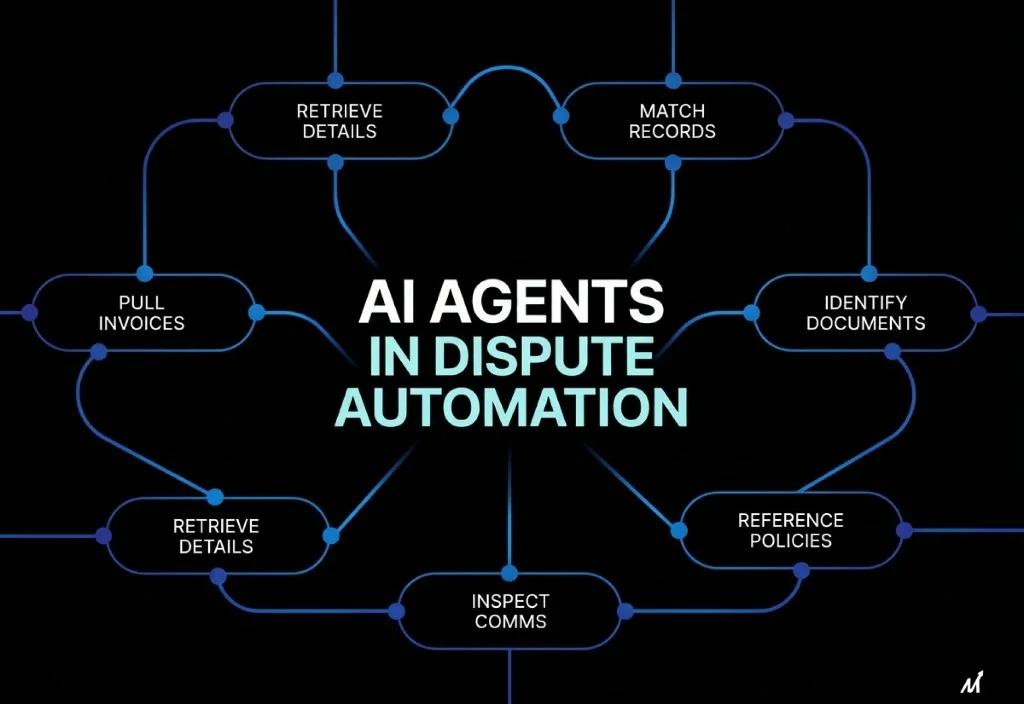
AI agents are changing what automation means in dispute operations. A traditional automation flow follows fixed rules: if X happens, do Y. That works for simple tasks, but chargebacks are rarely simple. Evidence is spread across systems. Emails are unstructured. Policies vary by merchant. Processor requirements differ. And every deadline matters. That is where AI agents become powerful.
An AI agent is not just a text generator. It is an orchestration layer that can reason through a task, pull information from multiple sources, and coordinate the work required to move a dispute forward.
In the context of chargebacks, that means helping determine whether a case should be refunded, contested, or escalated and then triggering the right evidence and submission workflow with far less manual effort. Behind this is a layer of LLM-powered systems that interpret dispute data, retrieve relevant information, and prepare it for downstream workflows. The next section focuses on how evidence is gathered and structured.
The Evidence Collector Agent
The evidence collector AI agent forms the foundation of the dispute workflow—designed to operate like a digital dispute analyst in the background. As disputes enter the system, it begins assembling the information required to support a complete case. It can retrieve transaction details, match order records, pull invoices and fulfillment evidence, inspect forwarded customer communications, reference merchant policies uploaded during onboarding, and identify which supporting documents are relevant for the dispute type.
Retrieve transaction details and match order records automatically
Pull invoices, fulfillment evidence, and policy documents from onboarding storage
Analyze forwarded emails turning inbox records into structured evidence inputs
Identify missing evidence and flag gaps before submission
Organize materials by evidence type and generate structured case summaries
Prepare submission-ready documents in processor-expected formats
Using a File API, merchants can upload key business materials once during onboarding — refund policies, terms of service, shipping policies, return rules, product descriptions, and fulfillment standards. Instead of asking merchants to locate and upload the same files every time a case needs to be contested, the AI agent retrieves the relevant policy content when it is needed and uses it as part of the evidence package or case reasoning workflow. That alone removes a meaningful amount of repetitive work.
But the evidence collector agent goes further. It can also work with forwarded emails and other inbound records so that merchants do not need to manually download messages, convert them into screenshots, and attach them one by one. Customer communications, order confirmations, shipping notifications, delivery updates, support responses, and related records can be analyzed, structured, and turned into usable evidence inputs. What was once buried in inboxes becomes part of a searchable, organized dispute workflow.
The Role of Large Language Models
Large language models play a specific role inside that workflow. They are not there to "magically win chargebacks." They are used to interpret messy information, summarize the story of a case, extract key details from documents and communications, identify missing evidence, and help create a cleaner case narrative. In other words,
The LLM becomes one tool inside the agent workflow — useful for reasoning, summarization, classification, and drafting but always grounded in actual merchant data and evidence.
Around that core, other AI capabilities can be layered in:
Document parsing to read invoices and receipts
Entity extraction to identify transaction IDs or customer names
Classification models to detect dispute types or evidence gaps
Ranking logic to prioritize the strongest supporting materials
Workflow logic to determine what should happen next
Together, these tools help the agent move from raw inputs to an organized, processor-ready output. That output is what merchants care about. The goal is not simply to collect files. The goal is to create a complete and credible dispute package. The AI agent can assemble relevant records, organize them by evidence type, generate structured summaries, and prepare submission-ready documents in the format expected by the processor or network. Instead of merchants stitching together screenshots, PDFs, and notes by hand, the system can do much of the operational heavy lifting while keeping merchant oversight where it matters. A useful way to think about the evidence collector AI agent is the conductor, and every evidence source is an instrument. Payments data, policies, CRM notes, shipping records, forwarded emails, and uploaded files all produce useful signals, but on their own they are disconnected. The agent brings them together into one coherent case.
What This Means for Merchants
Efficiency
Less manual work and faster case preparation across every dispute type

Consistency
Fewer missing documents and more consistent evidence packages every time

Scale
A dispute workflow that grows without requiring headcount to match

Control
Merchant judgment and oversight applied where it actually matters most

The Right Model: Guided Automation
It is also important to be realistic about what agent automation should do.
A well-designed AI agent does not remove merchant judgment. It does not blindly submit weak cases. It does not operate as an uncontrolled black box. The right model is guided automation: let the agent collect, structure, summarize, and prepare; let the merchant or policy layer decide where oversight, approval, or escalation is required. That balance is what makes AI automation trustworthy in a high-stakes workflow like chargebacks.
This is the direction dispute operations are heading.
The future is not just better dashboards or faster drafting. It is AI agents that can coordinate the full evidence workflow from intake, to retrieval, to analysis, to packaging, to submission preparation. Merchants who adopt these systems will be able to operate with more consistency, more speed, and far less operational friction.
Revivflow is being built for exactly this shift: an AI-powered dispute operation where evidence collector agents, file retrieval, LLM reasoning, and workflow automation work together to help merchants recover revenue with less manual effort and more control.